
Weaponized Compromise: Why the Epstein Files Prove International Cabals Aren't Just Myth!

Ever since my undergraduate years, I have been captivated by the seductive, enduring idea that our world is quietly governed by unseen hands—a shadow cabal guarding esoteric truths and pulling the levers of history from the dark. In lecture halls and library stacks, I traced how this obsession with secret influence spans millennia, evolving through distinct waves of lore: from the shadowy rituals of the Knights Templar and the fabricated lineage of the Priory of Sion to the world-dominating machinations ascribed to the Illuminati, the cryptic quatrains of Nostradamus, and the untranslatable ciphers of the Voynich manuscript.
As my interest deepened, I realized that the narrative often pivoted from mystic cults to high finance—from Renaissance titan Jakob Fugger, whose immense fortune bankrolled imperial wars and shaped Holy Roman Emperors, to the Medici family's strategic maneuvers to capture the Papacy and control the Catholic Church, and later to the Rothschild dynasty's sprawling international banking networks financing entire European conflicts. Yet while these historical accounts and mythical brotherhoods often blur into folklore and sensational fiction, the modern era has laid bare a far more disturbing, real-life reality: the actual existence of a shadowy, international elite whose influence was secured not through ancient rites, cosmic ciphers or finance, but through a calculated honeypot scheme. Jeffrey Epstein and his vast network demonstrated that the true "secret knowledge" capable of bending global power wasn't esoteric wisdom or balance sheet leverage—it was raw, weaponized compromise, capturing high-profile figures across politics, finance, and academia within a very real, documented shadow network of teen sex workers. This story began unravelling in the spring of 2019, and was recently recounted publicly by Senator Sheldon Whitehouse. Here, I have liberally recounted the Senator’s narrative about the U.S. president being implicated in a conspiracy orchestrated by Vladimir Putin, his operatives, and allies.
Public and media interest in Special Counsel Robert Mueller’s report into Russia’s election interference operation reached a fever pitch. There had been a steady drip of reporting on the Trump team’s cozy and peculiar relationship with Moscow.
Ahead of the Mueller report’s release, Trump’s Attorney General, Bill Barr, issued a letter to Congress purporting to summarize the findings, declaring that Russia and the Trump campaign did not collude to steal the election. The press, ravenous for news, largely accepted Attorney General Barr’s narrow, carefully worded conclusion and blasted it around the world before accessing the full report. Trump declared in all caps: “NO COLLUSION.” He claimed he had been cleared of the “Russia hoax.”
Frustrated, Mueller wrote to Barr stating that the letter did not fully capture the context, nature, and substance of the investigation. When the dense, voluminous Mueller report was finally issued a month later, its message had been obscured. The Mueller report actually concluded that the Trump campaign knew of, welcomed, and expected to benefit from Russian interference—a conclusion later echoed by a bipartisan report from the Senate Intelligence Committee.
By then, Barr’s scheme had largely worked. Many in the media and the Democratic Party internalized that the Russia speculation had gotten out of hand. But were they wrong? Let’s look at what Trump has done for Russia lately—usually at the expense of American interests.
10 Actions Trump Has Taken Benefiting Russia
Paused Ukraine Weapons Shipments: After Trump and Vice President Vance theatrically chastised Ukrainian President Zelenskyy in the Oval Office, Trump paused U.S. weapons shipments to Ukraine.
Blocked Patriot Interceptors: During a severe Russian bombing campaign, Trump paused an already funded weapons shipment for Ukraine, including Patriot interceptors that protect civilians.
Halted Russian Sanctions: Trump’s Treasury Department stopped imposing new sanctions and closing loopholes, allowing dummy corporations to send funds, microchips, and military equipment to Russia.
Backchannel Peace Negotiations: Leaked phone calls revealed White House envoy Steve Witkoff and Putin envoy Kirill Dmitriev working closely behind the scenes on a peace deal favorable to Russia.
The Alaska Summit: Trump rolled out the red carpet for the Russian dictator on American soil, yielding no gains toward ending the war in Ukraine.
Parroting Kremlin Talking Points: Trump’s Vice President traveled to the Munich Security Conference to parrot anti-Western rhetoric pushed by right-wing groups funded by Putin.
Intelligence Leadership: Trump appointed Russia apologist Tulsi Gabbard as Director of National Intelligence, to the delight of Russian state media.
Ending Kleptocracy Prosecutions: Upon Attorney General Pam Bondi’s confirmation, the DOJ shuttered its anti-kleptocracy unit targeting Putin’s oligarchs.
Transactional Foreign Policy: Trump unveiled a new National Security Strategy abandoning traditional European alliances, praised by the Kremlin as “consistent with Moscow’s vision.”
Re-integrating Russia into Sports: The administration paved the way for Russia’s return to global sports competition despite the invasion of Ukraine and systemic doping scandals.
If Trump were purposefully doing Russia’s bidding, it is hard to see what he would be doing differently. Senator John McCain used to say that Russia is “a gas station run by gangsters with an army.” Why is a U.S. President, who insists on being dominant in every relationship, so submissive to Vladimir Putin?
The Epstein-Russia Connection
Could this behavior have any connection to Trump’s close friendship with the late sex offender Jeffrey Epstein?
While much about Epstein remains unknown, survivors and millions of emails released through the bipartisan Epstein Files Transparency Act have shed light on his global network. Over and over, the trail touches Russia. When asked by a reporter about the Epstein files, Trump responded: “It’s just a Russia, Russia, Russia hoax.” Remarkably, when asked about Epstein, Trump’s mind went immediately to Russia.
1. Early Ties: The Barr Family & Wall Street
Epstein’s career began in the mid-1970s at the prestigious Dalton School in New York. Despite dropping out of college, 21-year-old Epstein was hired to teach high school mathematics. The outgoing headmaster who hired him was Donald Barr—father of future Attorney General Bill Barr and a former WWII intelligence officer. Epstein leveraged these connections to land a job at Bear Stearns before launching his own firm.
2. Robert Maxwell and Intelligence Networks
Epstein later connected with British defense contractor Douglas Lease and media mogul Robert Maxwell (father of Ghislaine Maxwell).
Robert Maxwell was a complex figure with ties to British (MI6), Soviet (KGB), and Israeli intelligence.
A secret document signed by the head of the KGB before Maxwell’s death in 1991 indicated he was a political asset for the Soviet Union.
Journalist Vicky Ward reported that former Epstein mentor Steven Hoffenberg claimed Epstein worked with Robert Maxwell on national security issues involving blackmail, influence trading, and arms dealing.
3. Trump and Epstein’s Close Bond
In the 1980s, Epstein befriended Donald Trump. Author Michael Wolff noted: “They shared everything. They shared their airplanes. They shared women between them.”
In 2002, Trump famously stated: “I’ve known Jeff for fifteen years. Terrific guy... It is even said that he likes beautiful women as much as I do, and many of them are on the younger side.”
Alan Dershowitz noted that in those days, “If you didn’t know Trump and you didn’t know Epstein, you were a nobody.”
Multiple accounts detail Trump and Epstein interacting with young women at Trump Tower, Mar-a-Lago, and private events. Ghislaine Maxwell famously recruited 16-year-old Virginia Giuffre from the spa at Mar-a-Lago.
4. The Russian Women and Modeling Pipeline
Author Craig Unger (American Kompromat) noted that women in Trump’s orbit often ended up associated with both Trump and Epstein.
Among them was a Russian beauty pageant contestant (Miss Baltic Sea 1994) who moved into a condo in Trump Tower before flying on Epstein’s private jet (Lolita Express) with Maxwell and Prince Andrew in 1999.
Epstein’s associate, French model scout Jean-Luc Brunel (who later died in prison while facing sex trafficking charges), was accused of procuring young girls from Eastern Europe and Russia.
Financial Trails, Blackmail, and Russian Intelligence
Epstein’s operations left a vast financial and intelligence trail leading back to Moscow:
The Palm Beach Mansion Deal: After Trump outbid Epstein for a Palm Beach mansion for $41.3 million in 2004, Trump sold it just four years later to Russian oligarch Dmitry Rybolovlev for $95 million—the most expensive residential sale in U.S. history at the time.
Political Advising: Epstein met frequently with Vitaly Churkin, Russia’s UN representative, emailing that Churkin “understood Trump after our conversations.” Epstein also advised former Norwegian Prime Minister Thorbjørn Jagland to suggest that Russian Foreign Minister Sergey Lavrov consult Epstein for insights on Trump.
FSB Ties: Epstein established connections with Sergey Belyakov, a graduate of Russia’s FSB Intelligence Academy.
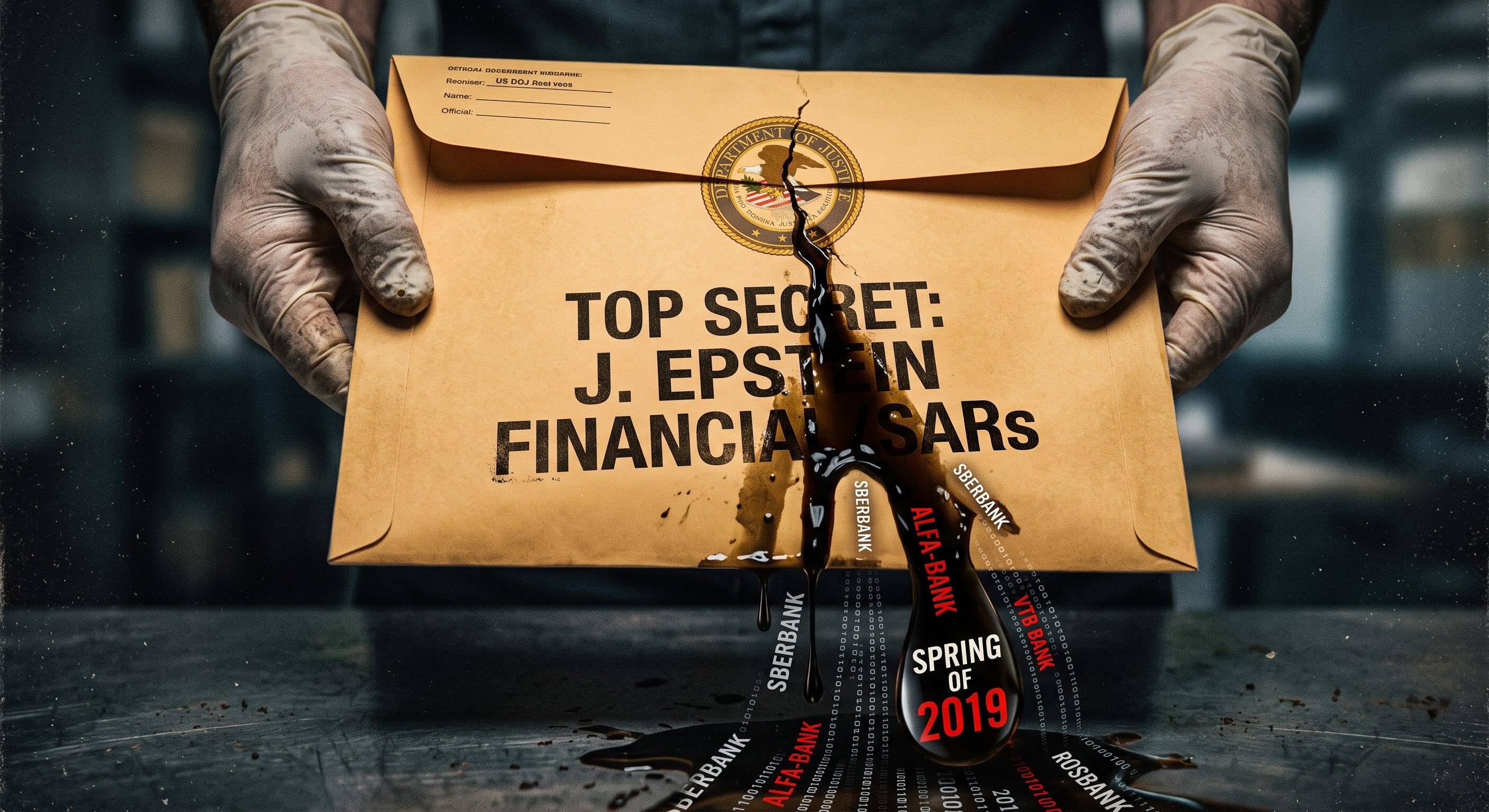
Financial Footprint: A SAR (Suspicious Activity Report) filed by JPMorgan Chase flagged $4.7 billion in wire transactions involving Epstein between 2003 and 2019, explicitly noting links to sex trafficking and the “high-risk jurisdiction of the Russian Federation,” including sanctioned entities like Alfa-Bank and Sberbank.
Blackmail and Surveillance: Multiple survivors and reporters noted that Epstein’s residences were equipped with extensive hidden surveillance cameras. Virginia Giuffre wrote that Epstein explicitly discussed using recorded encounters as blackmail to force powerful men to owe him favors.
What Is Right in Front of Us?
Former U.S. Attorney Alex Acosta reportedly claimed that Epstein “belonged to intelligence” and that his lenient 2008 plea deal was made “above his pay grade.” Polish Prime Minister Donald Tusk recently launched an investigation into whether Epstein’s pedophilia scandal was co-organized by Russian intelligence.
While Epstein was an inveterate liar whose claims must be vetted, the circumstantial evidence is extensive: Russian money, Russian financial transactions, Russian women, and deep ties to intelligence figures.
When you connect the official actions, the documented files, and the financial trails, the pattern becomes clear. Sometimes, with a little imagination, you have the chance to see what is right in front of your face.
The House of Windsor: Honeytraps and the Royal Pivot
While Prince Andrew’s deep entanglement with Jeffrey Epstein remains the most visible scar on the British monarchy’s modern standing, investigative scrutiny has increasingly turned toward the broader, systemic attempt to compromise the House of Windsor. The narrative of Epstein’s influence does not necessarily end with the disgraced Duke of York; rather, it highlights a recurring pattern of high-level intelligence access where vulnerable royals are targeted through carefully curated social circles.
In this context, critics and intelligence analysts have questioned the rapid, highly coordinated entry of Meghan Markle into the royal orbit. Emerging from the nexus of elite private clubs like Soho House—a global network heavily frequented by international power brokers, financiers, and high-end fixers—Markle’s trajectory intercepted the royal family at a crucial juncture. Parallel to the period surrounding the fallout of Prince Andrew’s compromising relationships, social networks overlapping with Epstein’s broader international web began to intersect with the younger generation of royals. Whether through orchestrated introductions at private retreats or strategically timed appearances at high-profile international gatherings, the seamless transition from Prince Andrew’s inner circle to Prince Harry’s private life reflects the classic mechanics of an influence operation. In the world of high-stakes statecraft and blackmail, when one conduit of influence becomes public and compromised, the machinery rarely shuts down—it simply pivots to the next vulnerable point of leverage.
Conclusion: The Anatomy of the Modern Cabal
Ultimately, the persistent allure of international conspiracy theories is not rooted in ancient mythology, but in the observable, repeatable behavior of the hyper-wealthy and the powerful. When vast fortunes operate beyond the reach of national sovereign laws, shielded by offshore banking, diplomatic immunity, and private security apparatuses, the conditions for real-world cabals become inevitable.
True international conspiracies do not require mystical rites or secret handshakes; they require only three elements: boundless wealth, sovereign impunity, and disposable accomplices. When like-minded elites—whether intelligence fixers, oligarchs, tech titans, or political dynasties—are granted access to hidden spaces behind closed doors, power ceases to be institutional and becomes deeply personal, transactional, and predatory. Through blackmail schemes, honeytraps, and weaponized compromise, these networks create a parallel system of governance where public officials are bound not to their electorates, but to the shadow ledgers of their own secrets. Until global institutions demand total transparency from the supranational elite, the line between historical paranoia and documented reality will remain dangerously thin.